


Ha Long Bay
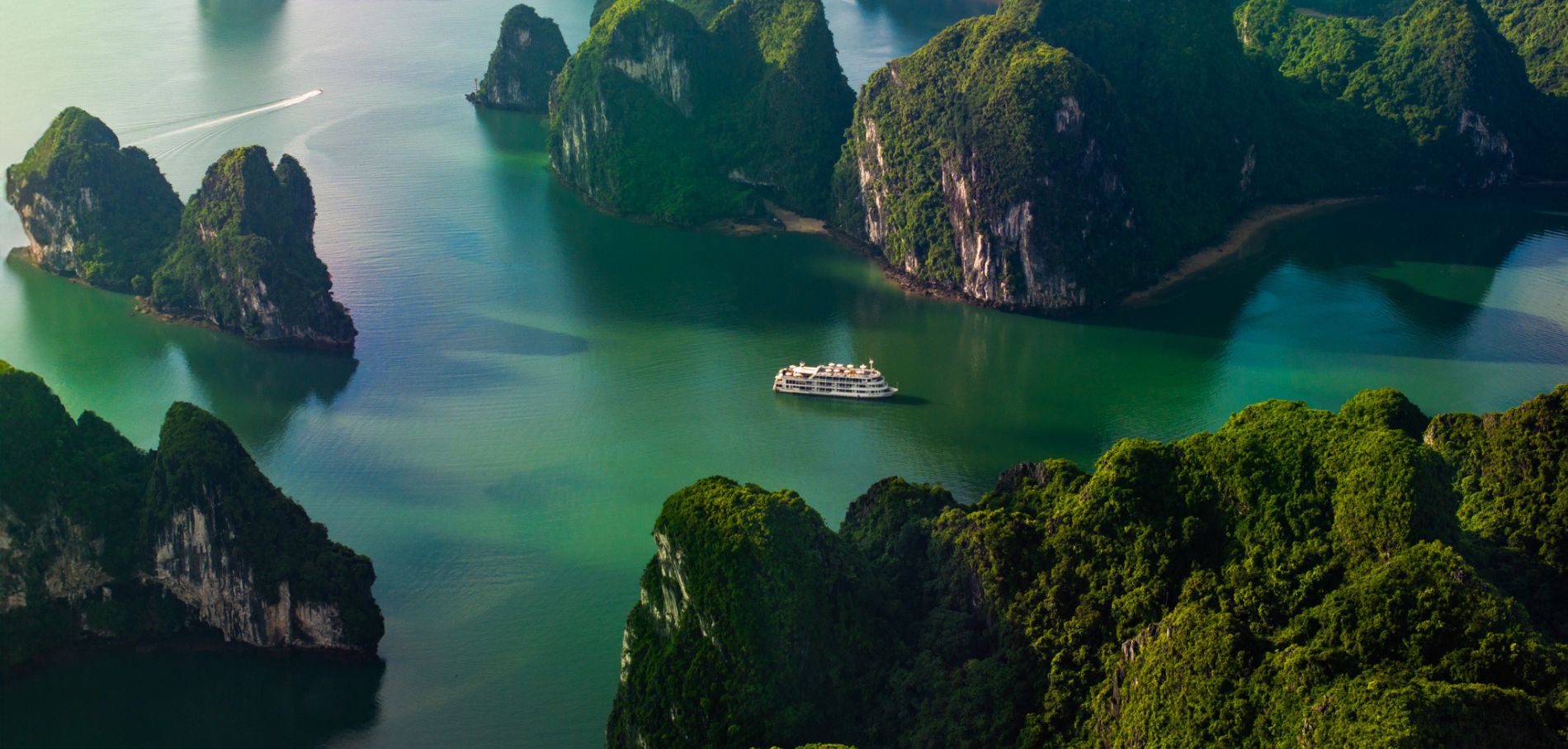
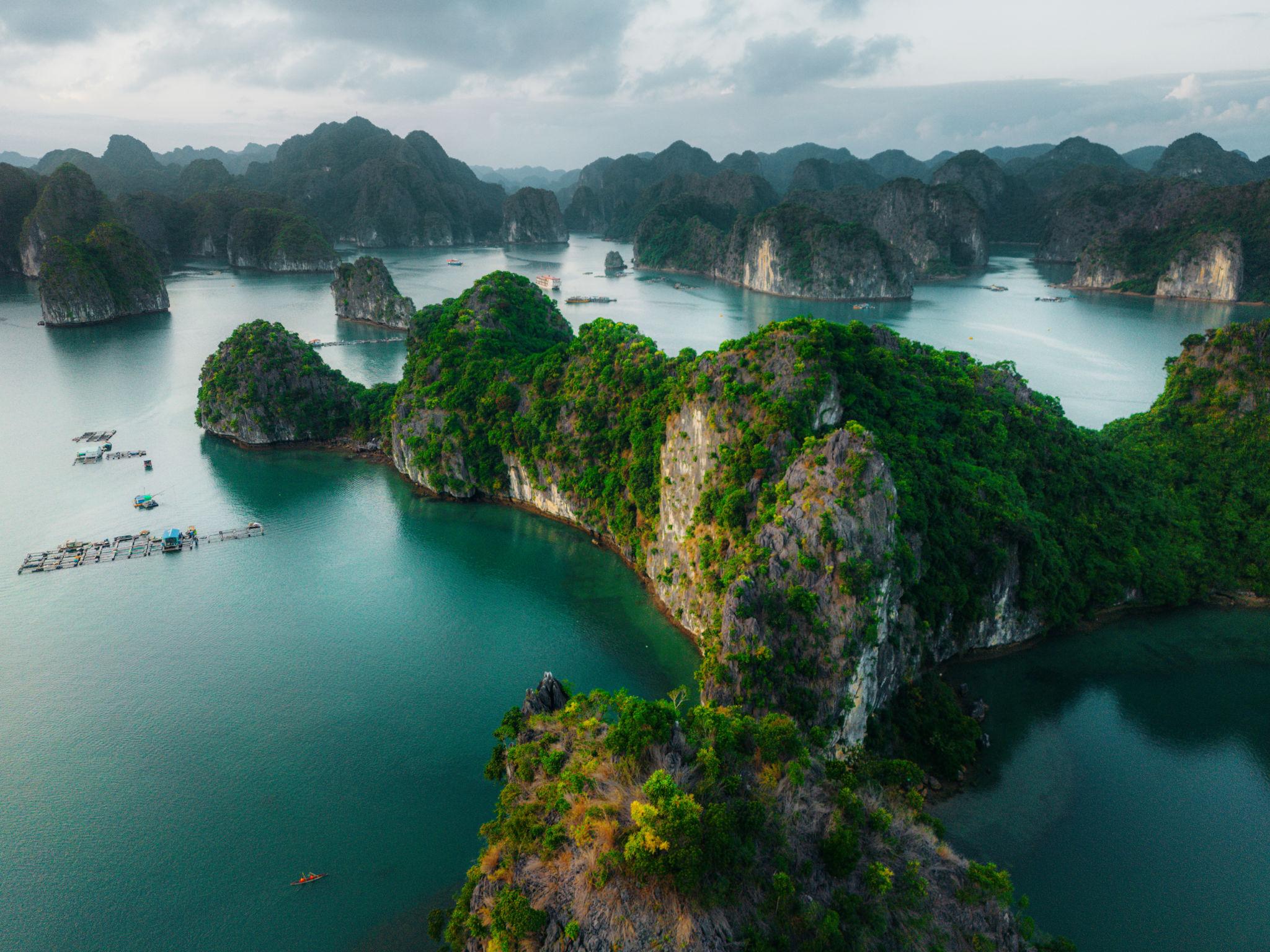
Ha Long Bay, meaning “where the dragon descends”, lies in north-eastern Vietnam. The bay was shaped by millions of years of weathering and karst erosion, leaving behind a dense cluster of limestone islands in countless forms, with outstanding scenic and scientific value.
UNESCO has recognised Ha Long Bay at three milestones. In 1994 it was inscribed for its aesthetic value; in 2000 it was recognised again for its geological and geomorphological value; and in 2023 the heritage site was extended to include the Cat Ba archipelago, affirming the ecological connection of the whole region.
Location
Ha Long Bay lies on the western shore of the Gulf of Tonkin, in Quang Ninh Province, about 160–180 km east of Hanoi. The bay borders Ha Long City, Cam Pha and part of Van Don District.
The bay covers around 1,500–1,553 km² with nearly 1,969 limestone islands and islets. Its core zone has a high density of islands, ideal for cruise routes. Many sights have become icons, such as Titop Island, Sung Sot Cave, Thien Cung Grotto, Dau Go Cave and Cua Van Fishing Village.
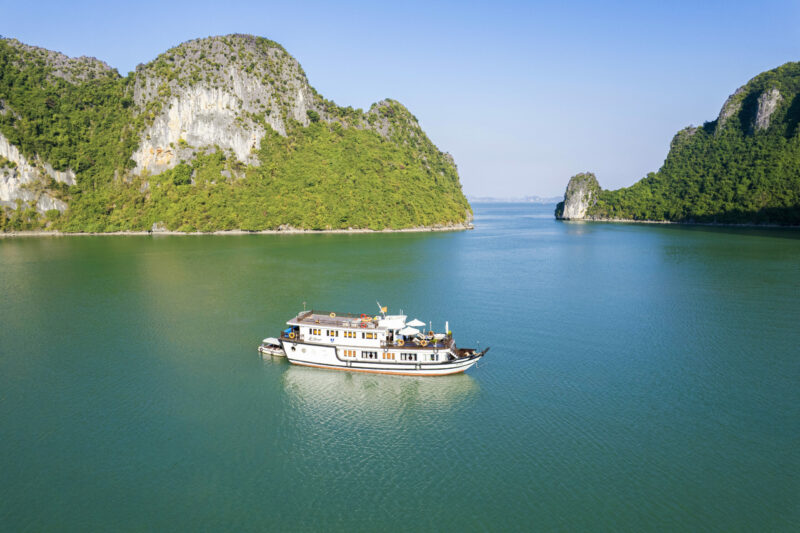
The bay stretches from Bai Chay and Hon Gai towards the Chinese border. To the north-east it connects with Bai Tu Long Bay – a quieter area with fewer boats – while to the south-west it joins Cat Ba and Lan Ha Bay, where Arcadia Luxury Cruise runs its multi-day itineraries.
This location opens up many different cruise routes. Guests can start from Tuan Chau Harbour, sail through the heart of the bay and then reach less-visited areas such as Bai Tu Long Bay and Lan Ha Bay.
Tourist Attractions
Me Cung Cave (Labyrinth Cave)
Me Cung Cave (also called Bung Sap) sits on top of Lom Bo Island, 25 m above sea level and about 2 km south-west of Titop Island. Part of Ha Long tourist route No. 2 (together with Sung Sot, Luon, Titop and Soi Sim), the cave is as mysterious as its name. It is over 100 m long with a complex, multi-chambered structure, and at the back a passage leads down to an underground lake called Me Cung Lake.
The flat entrance area covers about 40 m². Me Cung was once an archaeological site of the pre-Ha Long culture dating back 7,000–10,000 years: layers of Melania sea-snail shells can still be seen on the rock walls, and many primitive stone tools have been found here. Inside are stalactites of every shape and huge stone columns formed over tens of thousands of years. Visitors follow stone steps around the mountain into the cave and explore its hidden corners; from the deepest chamber you can see light reflecting off the lake below, creating a shimmering picture. The cave is often called an “ancient underground palace” of wild, majestic nature.
Highlights:
- Fossil shell layers: sediment layers of Melania shells cling to the walls, alongside large columns of ancient calcified oysters.
- Cave exploration: follow the trail and steps to discover stalactites in curious shapes, including great pillars said to resemble dragons and maidens.
- Underground Me Cung Lake: at the end of the route, a crystal-clear lake lies at the foot of the cave like a hidden river – a romantic spot to rest and take in the scene.
- Archaeological value: information boards introduce the early Ha Long culture; archaeologists describe the cave as a miniature “museum of nature and archaeology”.
Sung Sot Cave (Surprise Cave)
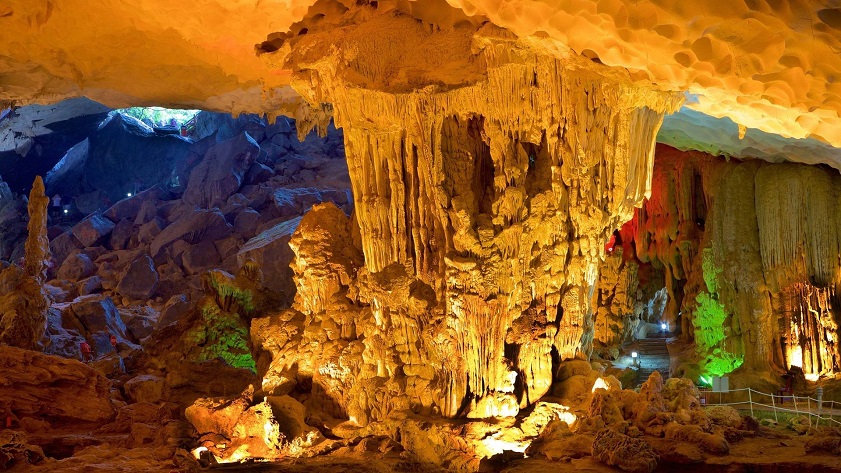
Sung Sot Cave (also known as Bo Hon Cave) is one of the most famous and beautiful caves in Ha Long Bay. It lies on Bo Hon Island, about 8 km north-west of Ha Long City. The cave was discovered in the early 20th century and opened to visitors in 1993.
It has two very large main chambers, the first like a giant natural “opera house” tens of metres wide. The ceiling and walls are covered with countless stalactites and stalagmites in fantastic shapes, and huge limestone columns run from ceiling to floor like pillars holding up a dome. Many visitors consider it one of the most beautiful and grandest caves in Ha Long.
Highlights:
- Cave visit: about 80 steps lead down to the lower chamber, then 60 steps up into the upper chamber, linked by a concrete staircase. Admire stalactites in white, pink and yellow and in striking shapes.
- Photography: coloured lighting makes the interior glow; wide-angle shots capture the whole cave.
- Guided tour: guides explain the cave’s karst formation and the story behind the name “Sung Sot”, meaning astonishment.
- Route connections: Sung Sot is usually the first stop on Ha Long route No. 2, followed by Luon Cave, Trong Island and Trinh Nu Cave.
